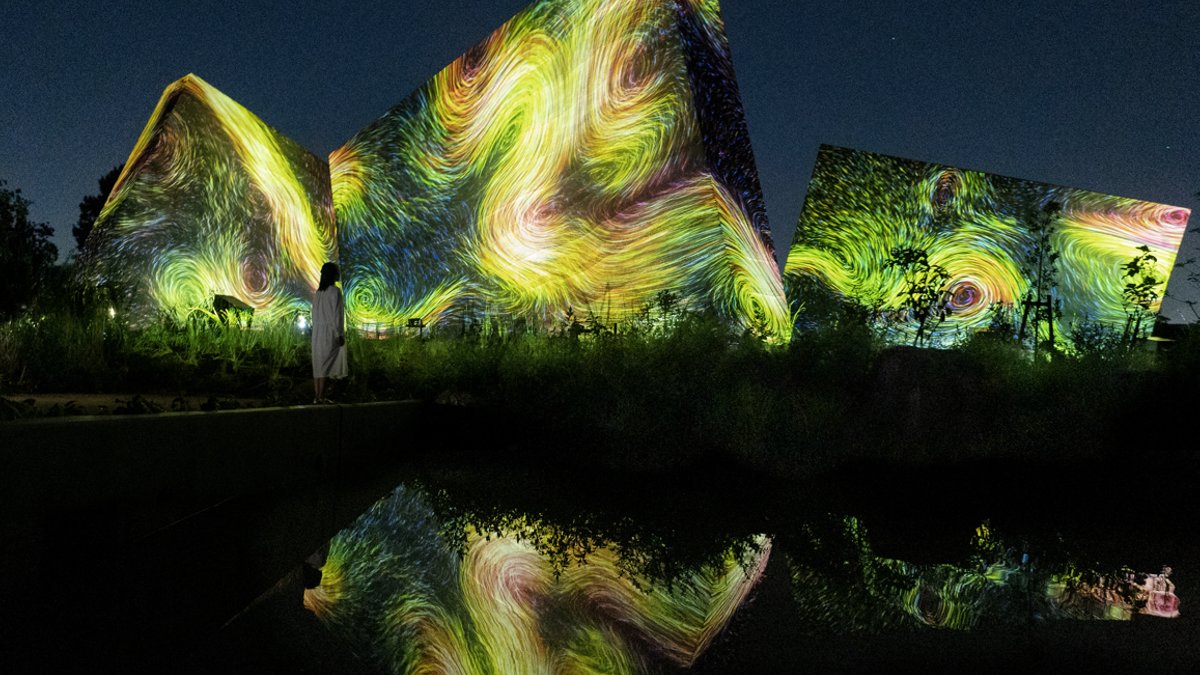
The most striking examples of teamLab’s work extend beyond museum walls. Across Japan, the digital art collective has redefined outdoor exhibitions by integrating technology with natural surroundings, crafting experiences that adapt to visitors in real time. While Tokyo’s teamLab Borderless remains its most celebrated indoor installation, three outdoor projects—each located in a different region—show how light, sound, and motion can transform abandoned or sacred spaces into interactive art environments.
Where Abandoned Terraces Become Digital Art
In a secluded coastal valley near Tokyo, Hidden Traces of Rice Terraces transforms a restored but underused agricultural site into an evening attraction. The exhibition centers on a series of repaired rice terraces, now bathed in floating lamps that shift with wind and movement, casting dynamic light patterns across the terrain. Visitors traverse the Water Mirror Path, where projections create the illusion of walking on water, merging digital elements with the valley’s natural shape.
The surrounding woodland features additional installations. Resonating Universe in the Tabunoki Tree suspends glowing spheres from branches, mimicking the underground mycelial networks that connect trees. Nearby, Concrete and Abstract projects laser beams onto foliage, as if scanning the environment live. At the sea’s edge, dynamic wave projections animate the water, while the Bamboo Forest of the Secret Valley converts motion into sound, amplifying leaf rustling into a rhythmic accompaniment.
Read Also: Singapore launches clinic-app hybrid for women’s health care
For those seeking deeper engagement, the site offers overnight accommodations in cottages or glamping tents, including an outdoor hot spring illuminated by floating lamps, an extension of the terraces’ digital glow. The exhibition remains accessible as a day trip from Tokyo, though its remote setting limits visitor numbers compared to urban locations.
A Botanical Garden Reimagined After Dark
Osaka’s teamLab Botanical Garden, launched in 2022, repurposed a neglected city park into a nighttime destination. The centerpiece, Resonating Microcosms in the Common Camellia Garden, features luminous ovoids, similar to those in Tokyo’s teamLab Planets, scattered across the forest floor. Approaching them triggers light and sound ripples, simulating a living ecosystem.
In Eucalyptus Park, larger ovoids arranged in a maze-like pattern respond to touch, tipping over and emitting sounds as visitors move through. The Sculptures of Dissipative Birds in the Wind showcase towering geometric forms adorned with digital swirls that replicate local bird flight patterns, grounding futuristic designs in the garden’s natural history. Seasonal displays, such as a summer sunflower field, rotate throughout the year, ensuring the experience evolves with the seasons.
A Sacred Park Transformed by Light
A Forest Where Gods Live represents one of teamLab’s earliest and most ambitious outdoor works. The park blends abandoned structures, sacred relics, and overgrown environments. TeamLab’s installations do not erase this history but instead enhance it.
Read Also: Thai Artisans’ Craftsmanship Celebrated in Resort Wear Collaboration
Projections like Ever Blossoming Life Rock turn boulders into cyclical displays of blooming flowers, while Universe of Water Particles on a Sacred Rock creates a silent digital waterfall among the trees. Inside a cave decorated with Buddhist figures, Spatial Calligraphy unfolds across the stone walls, merging ancient art with modern technology. The Azalea Valley pulses with light, animating the environment, while abandoned buildings host surreal additions like glowing monoliths in the Bath House Ruins.
The exhibition runs annually from July to November. Beyond the park, the adjacent hotel features teamLab’s Resonating Lamps in its lobby, and a separate-ticket sauna installation blends art with sensory immersion. Unlike the other sites, this one operates seasonally, aligning its existence with Japan’s natural cycles.
Accessibility sets these outdoor projects apart from teamLab’s indoor works. Hidden Traces of Rice Terraces requires a 90-minute train journey from Tokyo, deterring casual visitors, while teamLab Botanical Garden Osaka benefits from its urban location, attracting crowds after business hours. A Forest Where Gods Live, though remote, offers guided tours in Japanese, English, and Korean to accommodate international visitors. Each site balances exclusivity with public engagement, through overnight stays, seasonal rotations, or adaptive technology, ensuring the art remains interactive without overwhelming its surroundings.


