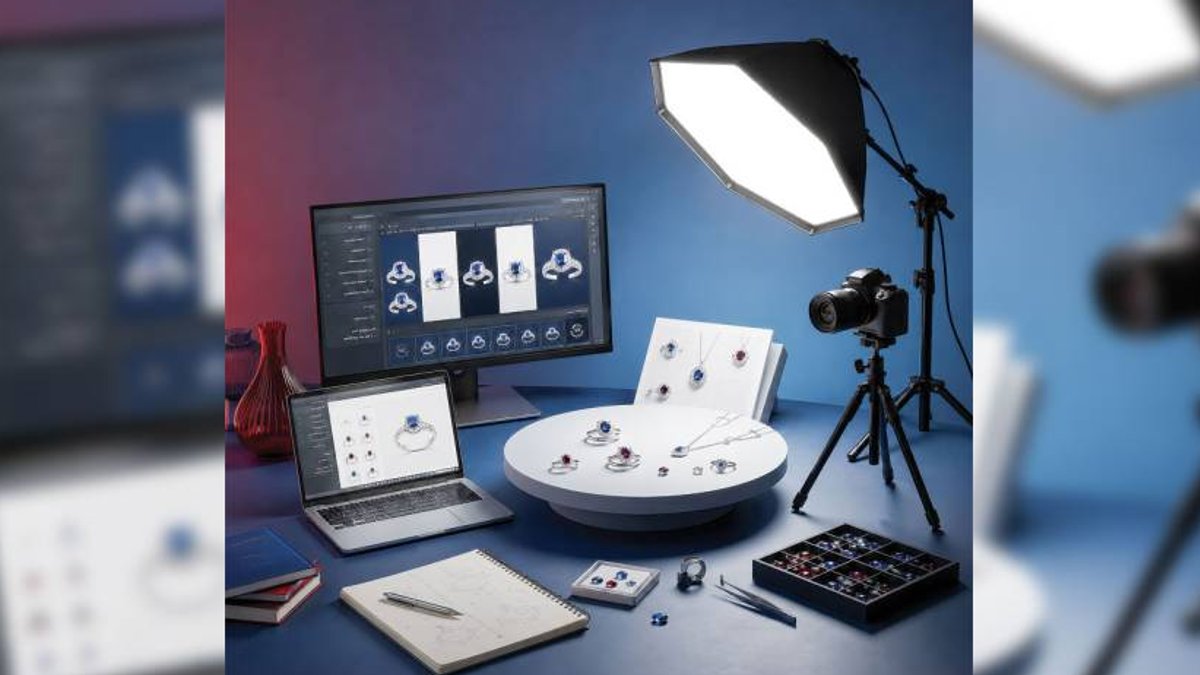
Artificial Intelligence (AI) is reshaping jewellery retail, but not in the ways often discussed. While consumer-facing tools like chatbots grab headlines, a quieter revolution is underway in the back offices of jewellery businesses.
Retailers are turning to AI to streamline repetitive, time-consuming tasks in content production, customization, and visual consistency. These systems don’t replace human creativity but enhance it, allowing teams to work faster and scale operations without sacrificing quality.
Where traditional workflows fall short
Modern jewellery retail demands a vast array of visual content. High-quality images, videos, and lifestyle visuals are essential across multiple platforms. Customers also expect to explore various gemstone and metal options before purchasing.
Behind the scenes, workflows remain fragmented and labour-intensive. Tasks like selecting frames, removing backgrounds, and maintaining consistent scale are repetitive but essential. Legacy content adds complexity, as older images often fail to meet current standards.
AI in action: Transforming workflows
AI systems in jewellery retail operate largely behind the scenes, automating rule-based tasks while leaving creative decisions to humans. For instance, gemstone content production has been transformed by automating processes like cine-loop selection, background removal, and shadow creation. This reduces processing time from 30-40 minutes to just two minutes per gemstone, improving consistency and quality.
Legacy imagery is another area where AI shines. AI-based super-resolution and segmentation enable retailers to upgrade hundreds of older images without re-shooting, ensuring visual consistency across their catalogue. Customization, once a labour-intensive process, is now more scalable thanks to automated gemstone fitting and standardized rendering pipelines.
The benefits extend to customers as well. Faster content production means quicker product launches, while consistent visuals enhance brand credibility and reduce buying friction. Rich, detailed visuals are key in bridging the sensory gap of online shopping, as emphasized by both industry experts and academic research.
Read Also: George Brown halts jewellery program enrollments
For Canadian jewellery retailers, these advancements are particularly relevant. Facing leaner teams and tighter margins, automation offers a way to increase operational capacity without significantly expanding headcount. By streamlining workflows, retailers can respond more quickly to demand, expand their assortments, and maintain consistent presentation across digital channels.
The Human Element in AI-Driven Workflows
For instance, while AI handles frame selection, background removal, and shadow creation, human expertise remains essential for perceptual judgments like gemstone colour accuracy. This ensures that the final output meets the highest standards of quality and consistency.
Industry surveys highlight the growing demand for frequent product imagery updates. Nearly half of jewellery brands refresh their images quarterly, often editing hundreds of images monthly. Automation allows teams to manage this volume without compromising on quality or creativity.
AI-Driven Solutions for Legacy Content and Customization Challenges
Legacy gemstone imagery often falls short of modern e-commerce standards, with issues like small stone sizes, low resolution, and unavailable source footage. AI-based scale normalization ensures consistent stone size across images, preventing visual inconsistencies. Colour correction, however, remains a human-controlled process, as accurate gemstone colour cannot be determined algorithmically alone. The system generates varied galleries of colour-corrected options, enabling humans to select the closest perceptual match.
AI-based super-resolution addresses the challenge of enlarging legacy images to meet current layout and resolution requirements. By applying this technology conservatively, retailers can increase resolution while preserving edge detail, avoiding the blur and loss of detail associated with traditional upscaling methods. Automated gemstone segmentation enables reframing, ensuring stones occupy a defined portion of the image and producing consistent composition across different products.
In customization, AI streamlines the production of visual content for made-to-order jewellery. By automating gemstone fitting into settings and deploying rendering pipelines to cloud resources, retailers can visualize a broader range of configurations consistently. This reduces manual work from 45 to 90 minutes per item to mere minutes spent on quality assurance, making customization a scalable offering rather than a labour-intensive exception.
The impact of AI-driven workflows extends beyond operational efficiency to enhance the customer experience.


