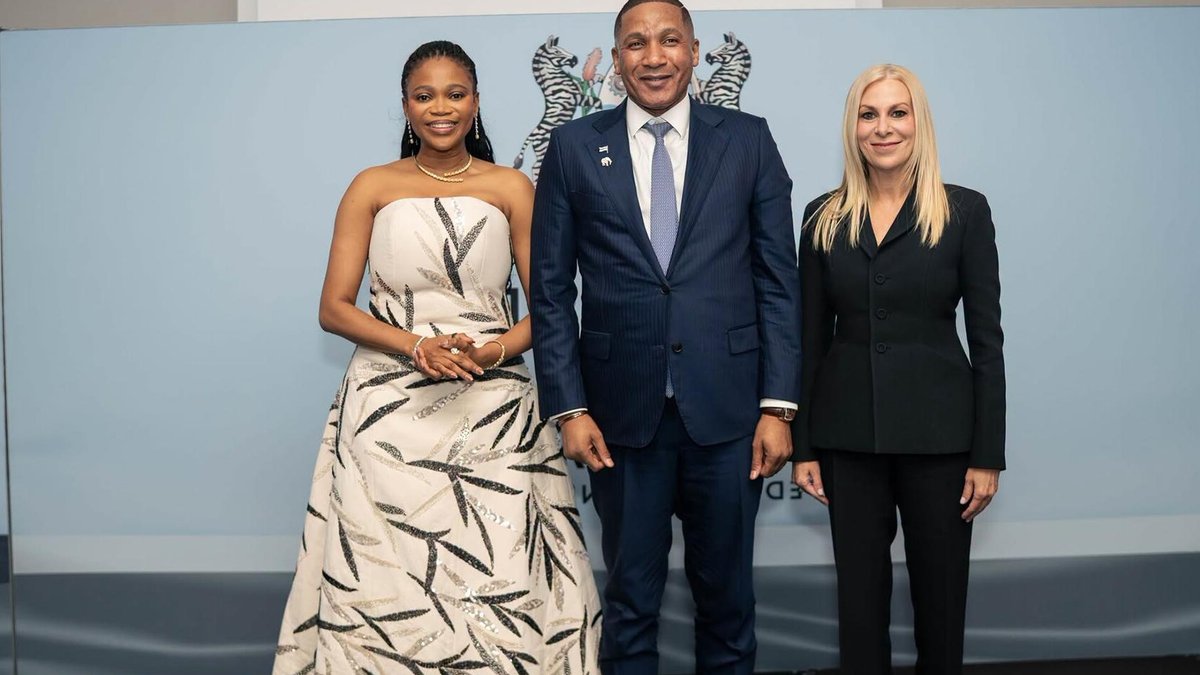
Botswana President Duma Boko and De Beers CEO Al Cook both signaled last week that diamond demand is stabilizing after years of volatility, with industry data showing price recovery in key segments. Their remarks came during high-profile events in New York City, where Botswana promoted its role as a leader in diamond production and democratic governance.
Diamonds as the engine of Botswana’s growth
Boko highlighted how diamonds transformed Botswana from a country with minimal infrastructure—just three miles of paved roads six decades ago—to a regional economic power. Revenue from diamond mining has funded schools, healthcare, and road networks, though he acknowledged persistent challenges like youth unemployment and strained public services. His administration has pledged to accelerate economic diversification while strengthening Botswana’s position in the diamond trade.
In a speech at Rockefeller Center, Boko framed diamonds as both an economic and symbolic asset. “You can see where we began,” he said, contrasting Botswana’s early struggles with its current standing. “The diamond came into the picture” and reshaped the nation’s trajectory, until recent market downturns threatened that progress. Now, he said, demand is “bouncing back,” offering renewed hope for job creation and foreign investment.
Boko also positioned Botswana as a model for democratic transitions, citing his smooth victory over incumbent President Mokgweetsi Masisi in 2024. Masisi conceded defeat publicly before vote counting finished, a gesture Boko described as proof of Botswana’s stability. “This peaceful handover of power sent a message to the world that Botswana is the exemplar of democracy on the African continent,” he said. “I think Botswana is, on the African continent, right now the best place.
It will lead. It will also sparkle and scintillate like the diamond and be an example to the rest of the continent, and indeed to the world, including, by the way, the United States of America.” It also, he added, sent a message to the world that Botswana provides a safe, predictable environment for investment.
Read Also: Retailers Struggle with Emotional Selling, Study Finds
Price trends show uneven but positive recovery
De Beers’ CEO Al Cook echoed optimism in an interview with China Global Television Network, stating that diamond prices are rising and demand is stabilizing. Industry analyst Edahn Golan, managing partner of Tenoris, provided data supporting this view: larger diamonds, those 1 carat and above, saw price increases of 3 to 4 percent month-over-month in August, a sharp rebound. The only exception was the 2-carat category, though Golan noted those prices had already risen earlier in the year.
Smaller diamonds, which had led the market’s recovery earlier in 2024, showed no August increase but may have risen in September, pending next week’s data. Year-over-year comparisons reveal mixed results: most categories remain below 2023 levels, but diamonds 3 carats and larger are performing “exceptionally well.” Golan’s August retail sales update also highlighted a growing divide in the market: lab-grown diamonds are gaining share at lower price points, while natural diamonds dominate at the high end.
A broader agenda beyond diamonds
Boko’s visit to New York included events beyond diamond-focused discussions. Held at Rockefeller Center, the Presidential Diamond Jubilee reception was one of three Botswana-related events that took place in New York last week while the president was in town for the UN General Assembly. The following evening, President Boko, First Lady Kaone Boko, and Minister Kenewendo, along with Venus Williams, Ciara, and Prince Harry, Duke of Sussex, attended an event co-hosted by De Beers and National Geographic.
The event, which took place during Climate Week NYC 2026, was organized to celebrate their Okavango Eternal partnership, which was just renewed for an additional five years. The partnership helps to protect and support the Okavango River Basin, a wetlands ecosystem that starts in the Angola Highlands and flows through Namibia and Botswana, providing food and water and sustaining life and livelihoods for the millions of people and animals.


